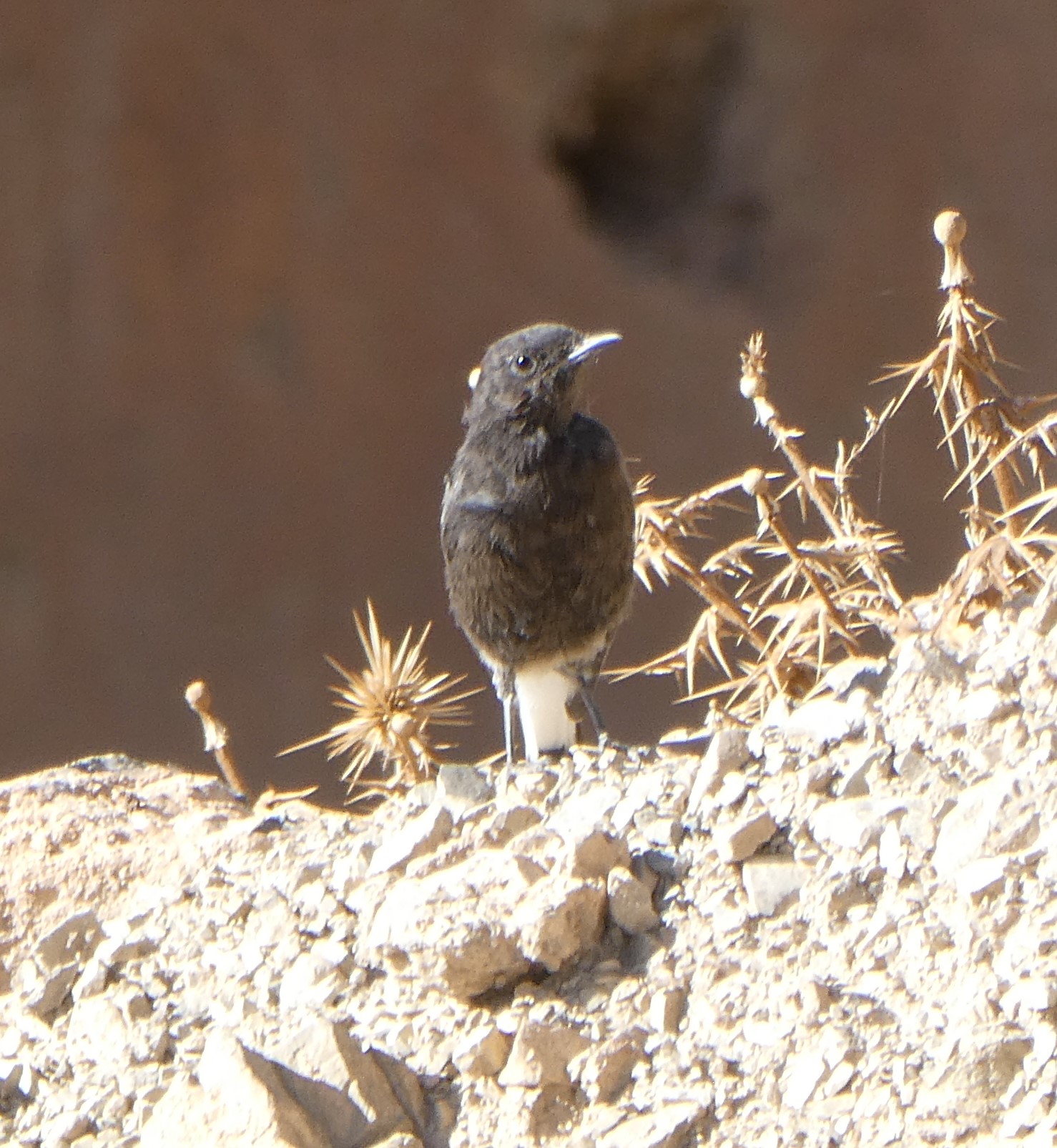
Flycatchers (Muscicapidae)
The blue rock thrush is a starling-sized bird, 21–23 cm (8.3–9.1 in) in length with a long slim bill. The breeding male of the nominate subspecies is unmistakable, with all blue-grey plumage apart from its darker wings. Females and immatures are much less striking, with dark brown upperparts, and paler brown scaly underparts
The stonechat is 11.5–13 cm long and weighs 13–17 g, slightly smaller than the European robin. Both sexes have distinctively short wings, shorter than those of the more migratory whinchat and Siberian stonechat. The summer male has black upperparts, a black head, an orange throat and breast, and a white belly and vent. It also has a white half-collar on the sides of its neck, a small white scapular patch on the wings, and a very small white patch on the rump often streaked with black.
The northern wheatear is larger than the European robin at 14½–16 cm length. Both sexes have a white rump and tail, with a black inverted T-pattern at the end of the tail.
The plumage of the summer male has grey upperparts, buff throat and black wings and face mask. In autumn it resembles the female apart from the black wings. The female is pale brown above and buff below with darker brown wings. The male has a whistling, crackly song. Its call is a typical chat chack noise, and the flight call is the same.